
How to Get Court Records
Know which court holds the file first. The MiCOURT Case Search is Ottawa's free public entry point. It shows a case number, type, status, events, and any hearing details on display. Treat the result as a research tool only. It can tell a 20th Circuit case from a 58th District or Probate matter. A screen view is not a clerk-issued document.
For actual paper, go to the office that keeps the file. The Circuit Court Records Division handles 20th Circuit civil, criminal, and domestic-relations records. District users should check the 58th District Court records page. It points to MiCOURT and the right local office. Probate files go through the Probate Register. You can request inspection or copies at the counter. Phone, email, and mail also work once the custodian confirms the cost and payment instructions.
- Identify the court and location from the case number, notice, citation, or MiCOURT result.
- Use the public search to confirm the case number, names as displayed, case type, and the document or date needed.
- Ask the responsible clerk for a docket history, order, judgment, other document, or certified copy. State whether certification is required.
- For a mailed request, contact that office first. Ottawa does not publish one generic court-copy mail form or one universal payment process.
- Provide a phone number or email for a clarification, then follow the office's current payment and delivery directions.
Note: A clerk can hand over records and explain procedural status, but cannot pick a legal strategy or draft legal documents for you.
Ottawa Court Record Channels
Why so many channels? Ottawa County keeps separate custodians for its trial courts. MiCOURT is the online search layer. The Circuit Records office, the District Court clerks, and the Probate Register handle copies and court-specific questions. Phone and email work well when a case is missing, an address is unclear, or you need to confirm a fee or delivery detail. For inspection and in-person service, the courthouse counter is still the direct route during published hours.
MiFILE plays a different role. Through MiFILE, Michigan litigants file documents and receive filing notices. It does not replace public case search, and it will not produce public document copies. Circuit and district e-filing rules can shape a litigant's filing route, but the clerk remains the source when you want a record in hand.
Types of Court Records
Match the request to the right office and item. The County Clerk/Register of Deeds maintains the 20th Circuit file after a felony bindover. That office also holds circuit civil, criminal, family, domestic-relations, and appellate records. The 58th District Court keeps its own civil, criminal, traffic, ordinance, small-claims, and summary-proceeding dockets. Estate, trust, guardianship, conservatorship, mental-health, drain-appeal, and related probate files sit with the Probate Register.
Keep the ask narrow when you can. A docket or register history is one thing. A specific order, judgment, transcript, exhibit, or payment history is another. Transcripts and exhibits carry their own availability and access limits. Naming the event or document helps the clerk route your request quickly.
- Public case history or register of actions
- Filed motion, order, judgment, or other document
- Circuit civil, criminal, or domestic-relations record
- 58th District civil, criminal, traffic, or ordinance case file
- Probate estate, guardianship, conservatorship, or related record
Ottawa Court Record Products
Three products, three purposes. A public MiCOURT result helps you find a case and scan the visible event history. A clerk-provided copy comes straight from the court file. It answers a document question far better than a screen view. A certified copy is the clerk-authenticated document. When official proof is required, it fills that role. Note that Ottawa's circuit fee page requires divorce judgments to be certified.
| Product | What it supplies | Ottawa route |
|---|---|---|
| Public case search | Visible case, status, event, and hearing information | MiCOURT Case Search |
| Clerk copy | A requested document or record from the court file, subject to access rules | Responsible Circuit, District, or Probate office |
| Certified document | A clerk-authenticated copy when official proof is required | Responsible clerk with current fee confirmation |
Ottawa Court Record Custodians
The 58th District Court is a single court with three public locations. It is not three separate municipal docket systems. Use the location printed on your citation, notice, or case result. Each site publishes direct civil, criminal, and traffic contacts. A request can land at the desk handling that case category. The District Court locations page also lists current addresses, hours, and fax numbers.
| 58th District location | Main line | Direct record channels |
|---|---|---|
| Grand Haven, 414 Washington Avenue | (616) 846-8280 | Civil: ghciv@miottawa.org Criminal: ghcrim@miottawa.org Traffic: ghtraffic@miottawa.org |
| Holland, 85 West 8th Street | (616) 392-6991 | Civil: holciv@miottawa.org Criminal: holcrim@miottawa.org Traffic: holtraffic@miottawa.org |
| Hudsonville, 3100 Port Sheldon Road | (616) 662-3100 | Civil: hudciv@miottawa.org Criminal: hudcrim@miottawa.org Traffic: hudtraffic@miottawa.org |
What a Court Record Contains
A public case record opens with the header. From there it lists the parties or entities. It also lists the court, case category, filing date, status, and assigned judge or referee. The event register is the chronological core of the record. It may show filings, service, appearances, motions, orders, settings, disposition, transfer, or post-judgment activity. What you can view or copy depends on the file and its public status.
| Case header | Case number, court, case type, filing date, status, and public-status classification. |
|---|---|
| Parties | Names and roles displayed in the public record, such as plaintiff, defendant, petitioner, or respondent. |
| Event register | A dated chronology of filings, hearings, orders, and other court activity. |
| Settings and outcome | Any visible next-hearing, disposition, closed date, or related case reference. |
| Filed documents | Orders, judgments, motions, and other material available from the clerk subject to access rules. |
Ottawa Court Record Request Details
Work from what the public record already shows. A complete case number is the best routing detail you can give. It should include the year and any type suffix. Names should match the public display exactly. Never add private identifiers just to speed things along. Spell out the item you want. That could be a docket history, order, judgment, register of actions, transcript, exhibit, payment history, or certified copy.
Add a date range or event date when it helps isolate the document. Say whether certification is necessary. Include a preferred delivery method and a reliable way to reach you. Finally, acknowledge that sealed, nonpublic, and protected material is excluded. That one line keeps a request for a case-history screen from being misread. It stops the clerk from reading it as a demand for every filed document.
Certified Copies and Fees
Two copy products come out of the Circuit Court Records file. A machine copy is plain and cheap. A certified copy carries the clerk's certification. That is what you want when authentication matters. The published circuit schedule splits the two costs apart. It lists a certification charge plus a per-page charge. It also notes that Circuit Records takes no personal checks. Call ahead for the final amount and payment instructions before you mail a request.
| 20th Circuit item | Published amount |
|---|---|
| Machine copy | $1 per page |
| Certified copy | $10 plus $1 per page |
| Divorce judgment | Certification required under the published circuit fee page |
The figures above come from the official circuit fee schedule. A 58th District request works differently. Send it to whichever office holds the case, and that office can confirm its current copy and certification costs.
Ottawa Court Record Counter
For 20th Circuit records, the contact is the Ottawa County Clerk/Register of Deeds, Circuit Court Records Division. It runs a records counter in Grand Haven. It also staffs a second location at the Family Justice Center in West Olive. Doors are open Monday through Friday, 8 a.m. to 5 p.m. One wrinkle: the county lists recurring morning closures. They hit the Grand Haven and West Olive circuit offices on the second Thursday. Check before you drive over.
Ottawa County Clerk/Register of Deeds, Circuit Court Records Division
414 Washington Avenue, Room 320
Grand Haven, MI 49417
(616) 846-8315
CircuitCourtRecords@miOttawa.org
Family Justice Center Records Location
12240 Fillmore, Room 50
West Olive, MI 49460
(616) 846-8315
Published fax: (616) 738-4638
Ottawa Court Record Filing Route
Filing electronically and pulling a public record are two different errands. Ottawa uses MiFILE for most circuit case types and for district civil litigants. People without equipment or access can request an MC100 exemption. MiFILE handles filing, payment, acceptance, rejection, and service notices. Even so, an electronically filed document may not get you a copy. The official court file is a separate matter. That can take a separate clerk-copy request.
The county's Circuit Court e-filing instructions walk through the local filing channel. To read a public case, start with MiCOURT. Then ask the responsible court clerk for a copy or certification. A filing account does not open the public record.
Public Access and Sealed Records
Michigan court records are open to inspection and copying by default. A statute, court rule, or sealing order can change that. So the public case screen is not a promise that every file will show up. Protected personal identifying information gets redacted or kept nonpublic. And a missing result may point to a restricted category. It does not mean the case is absent.
Michigan court-record rules:
MCR 8.119 provides the general inspection and copy rule for court records, subject to legal restrictions.
MCR 1.109 governs court records and protected personal information in filings.
MCL 15.231 states Michigan's FOIA policy, while court case access follows court rules and clerk procedure.
Note: When access runs into a wall, the responsible court can explain its records procedure. It cannot give legal advice on challenging a seal or restriction.
Ottawa Court Record FOIA Boundary
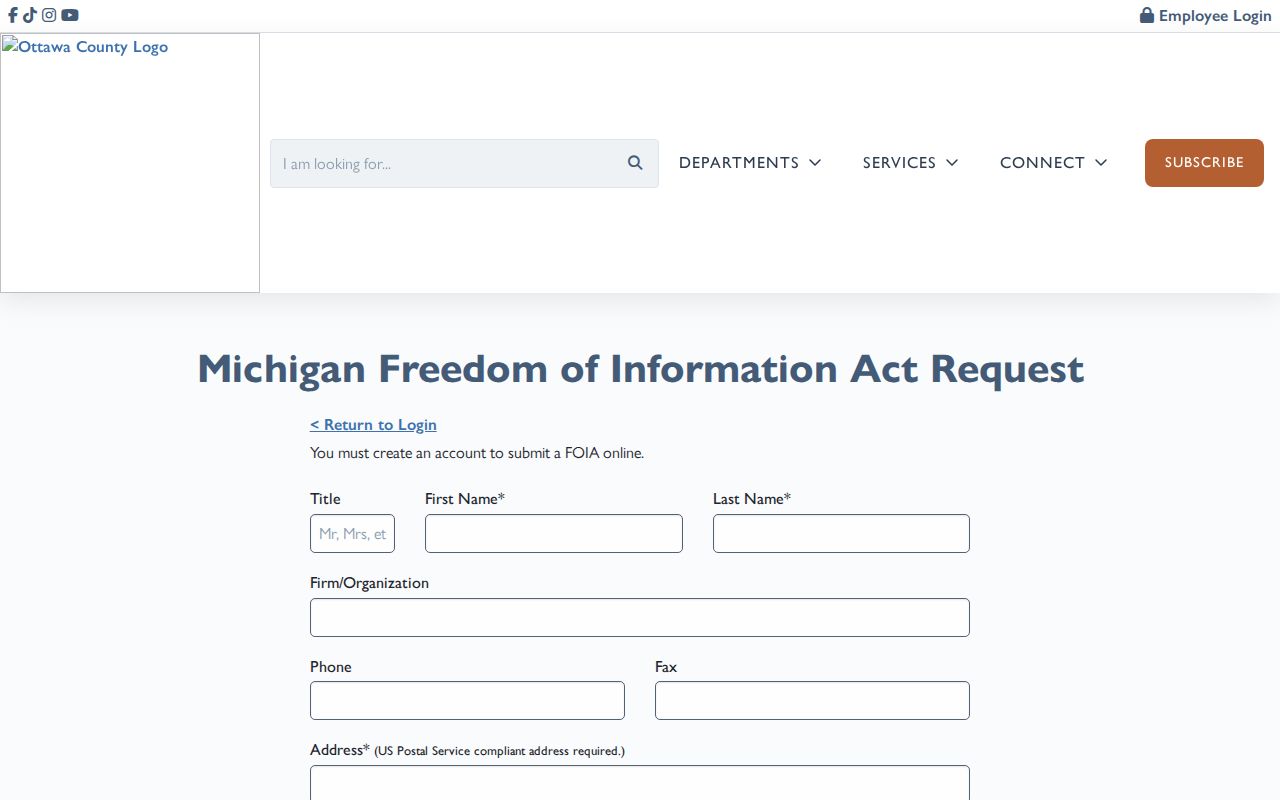
Ottawa's FOIA Tracker serves as the county-government request portal. First-time users must register before the workflow starts. But for a court docket or case file, Ottawa takes a different tack. It points searchers to MiCOURT and the court that holds the record. A FOIA request cannot override a court seal. Nor can it override a protected-information rule or a clerk's procedure for a court file.
Ottawa's official FOIA Tracker entry page lays out the account route for county requests. The public registration page asks for contact and account fields before any request can begin. That process fits executive-branch county records. It is not the normal route for a Circuit, District, or Probate court-record request.
The official Tracker sign-in page displays that account entry point. It helps explain why a court-file request belongs with the court itself. A routine FOIA case search is not the vehicle for it.
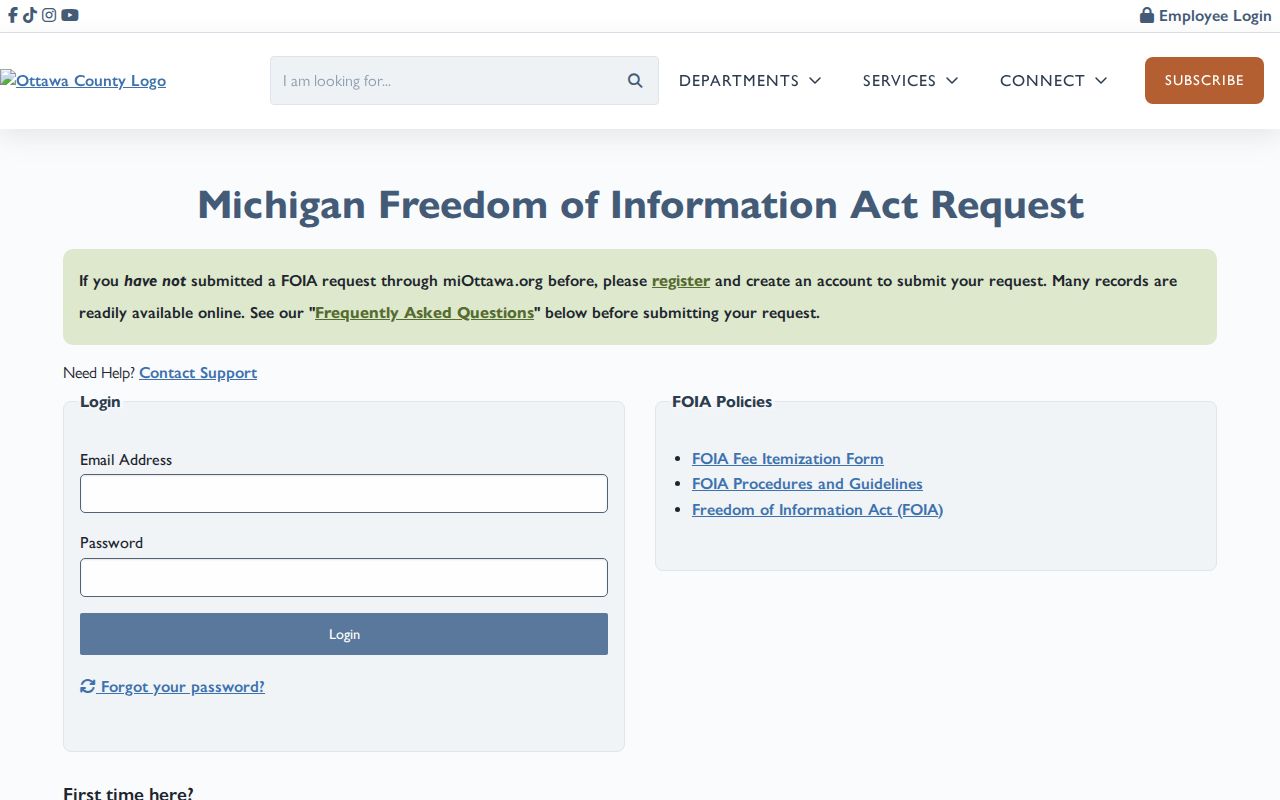
Registering with the Tracker supports the county's broader records process. It does nothing to the court rules that govern an Ottawa court record. The official FOIA Tracker registration page makes that plain: the workflow starts with an account, not a public court-docket form.
For a court file, the practical next step stays the same. Use MiCOURT, or ask the Circuit, District, or Probate records custodian directly.
Ottawa Court Record Access Limits
MiCOURT keeps several categories off ordinary public display. Adoption, juvenile and child-protective proceedings, juvenile guardianships, mental-illness matters, PPOs, name changes, wills, and other protected groups are among them. Juvenile and child-protective matters sit in the Family Division of the 20th Circuit and are generally nonpublic. So a result can be suppressed, limited, or absent even while the court keeps a record.
A set-aside conviction changes the picture too. Michigan requires set-aside conviction information to be redacted before the case record goes public. Authorized records may still be retained. When a public case is missing or old, check the statewide exclusions first. Then contact the court of record. MiCOURT also warns that some courts apply a seven-year criminal-sentence filter.
Ottawa Court Record Family Routes
Family and probate matters need careful routing. Public access differs across them. Circuit family and domestic-relations records live with Circuit Court Records. Probate questions go to the Probate Register at Room 200, 414 Washington Avenue, Grand Haven. Reach that office by phone at (616) 786-4110 or by email at probatecourt@miottawa.org. The Ottawa County Probate Court posts its contact and court information online.
When you call, ask for the specific public record or procedural status. Skip questions about rights or legal options. That keeps the request inside the clerk's role. It also protects the limits that cover sensitive family, juvenile, mental-health, and sealed material.